
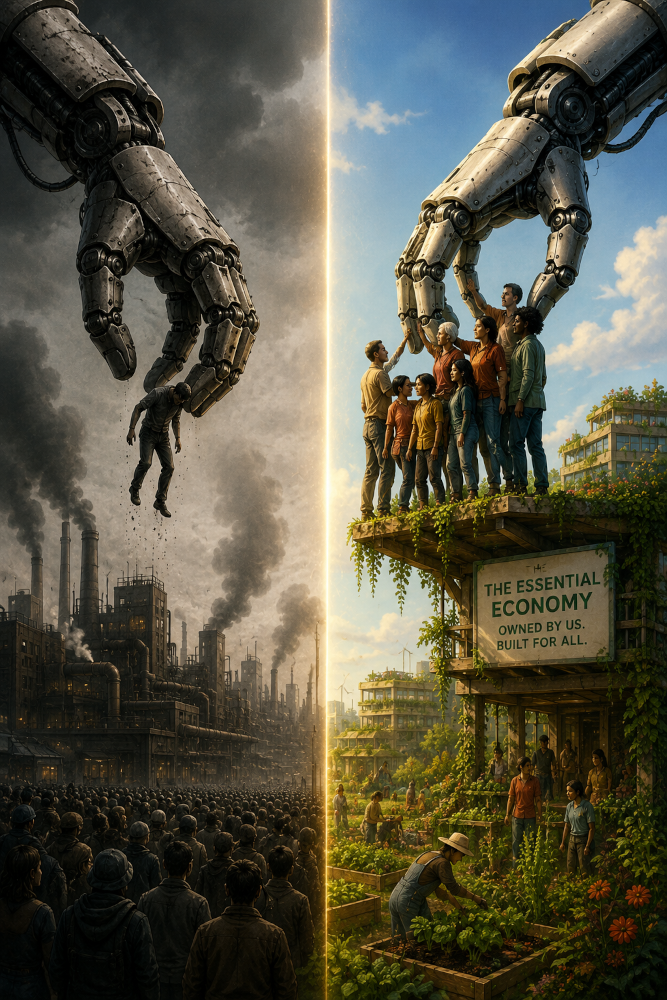
Technology is not the enemy.
Artificial intelligence. Robotics. Automation. These are not evil forces. They are tools—powerful tools that can either serve humanity or enslave it.
The question is not whether we should use them. The question is: Who owns them? And who benefits from their output?
In the Old Economy: Technology as Extraction
In the current system, AI and robotics are designed to do one thing: replace human labor and concentrate wealth.
- A factory installs robots. Workers are laid off. Profits go to shareholders.
- An AI system automates customer service. Call center workers lose their jobs. Savings go to the corporation.
- A self-driving truck replaces a driver. The company saves on wages. The driver is left with nothing.
This is not innovation. This is extraction. It takes the value created by technology and funnels it upward, away from the people who built the system, away from the communities that sustained it.
The result? More wealth for the few. More insecurity for the many. More fear. More competition. More suffering.
In the Essentials Economy: Technology as Liberation
Now imagine the same technology, owned by a different master.
- A community-owned factory installs robots. The workers become co-owners. The robots do the heavy lifting. The workers share in the increased profits.
- An AI system automates administrative tasks. The time saved goes back to the workers. They work less, earn more, and have time for family, creativity, and rest.
- Self-driving trucks transport goods for a member-owned cooperative. The profits circulate back to the community. The drivers are retrained for higher-value roles. No one is left behind.
This is not a fantasy. This is liberation. Technology becomes a tool that reduces human suffering, increases human freedom, and builds community wealth.
The Core Difference: Ownership
The difference between these two futures is not the technology itself. It is ownership.
| Old Economy | Essentials Economy | |
|---|---|---|
| Who Owns the Technology? | A few distant shareholders | The community / member-owners |
| Who Benefits? | Shareholders and executives | Every member of the community |
| What Happens to Workers? | Replaced, discarded, impoverished | Retrained, supported, enriched |
| Purpose of Technology | Maximize profit | Maximize human well-being |
What This Means for Us Today
Right now, the old economy is racing to develop AI and robotics as quickly as possible. They are not slowing down. They will not wait for us.
We must build the Essentials Economy at the same speed.
- We must own the platforms where these technologies are used.
- We must ensure that the benefits flow to the community, not just the few.
- We must create a system where technology serves our needs, not our fears.
A Simple Analogy
Imagine a tractor.
In the hands of a landowner, it plows the field. The landowner keeps the harvest. The workers get a small wage.
In the hands of a cooperative, the same tractor plows the field. The cooperative owns the harvest. The workers share in the profits. Everyone eats.
The tractor is the same. The difference is ownership.
AI and robotics are the tractors of the 21st century. Who will own them? Who will benefit from their labor?
The Choice Is Ours
We cannot stop technological advancement. We should not try. Technology has the potential to free us from drudgery, to heal the sick, to feed the hungry, and to build a world of abundance.
But that potential will only be realized if we own the technology together.
The Essentials Economy is not anti-technology. It is pro-ownership. It says: “Let us use the best tools available—but let us use them for the common good.”
A Call to Action
To every builder, every thinker, every person who reads this:
- Learn about AI and robotics. Do not be afraid. Understand what they can do.
- Demand ownership. Ask: “Who owns this technology? Who benefits?”
- Build the Essentials Economy. Join us. Own your food. Own your housing. Own your insurance. And when the time comes, own the machines that produce our abundance.
Technology is a tool. The question is: whose hands will hold it?
We are building the hands that will hold it together.
Join us. Books – GUCF